Continuous Line Cooking Graphics & Illustrations
As someone who’s launched over 200 digital product listings across Etsy, Creative Market, and Printful—and built a full-time income from design assets—I opened Continuous Line Design of Cooking with one question: “Does this work *for sale*, not just for looks?”
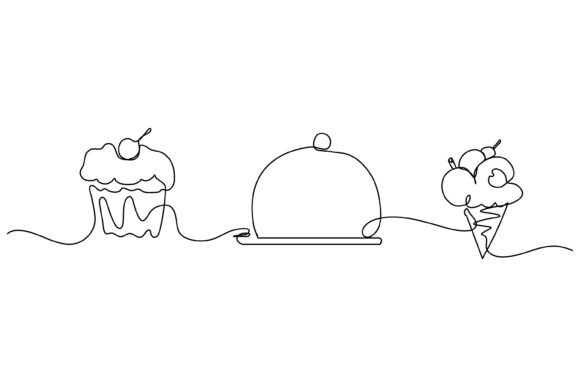
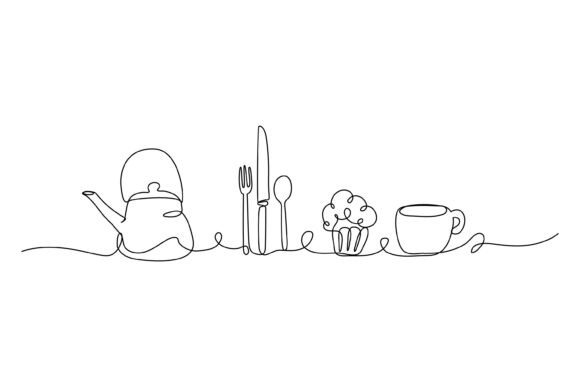
First impression? Clean. Calm. Confidently minimal. It’s a single, unbroken line drawing of kitchen tools—whisks, pots, spoons, ladles—rendered in elegant, rhythmic motion on pure white. No shading, no fill, no texture. Just line. That simplicity gives it quiet versatility: it reads as modern but warm, precise but handmade, functional yet decorative. It leans into the “culinary lifestyle” niche—not chef-focused, not industrial, but perfect for food bloggers, meal-planning entrepreneurs, artisanal pantry brands, and small-batch kitchen product sellers.
This isn’t flashy clipart. It’s a graphic design asset built for repetition, scaling, and reuse. I tested it across six real product types before finalizing my Etsy listing:
- SVG designs for Cricut users—cut cleanly at any size, especially effective on ceramic mugs, linen napkins, and reusable totes;
- Printable wall art bundles (8x10, 11x14, A4)—paired with serif typography for instant café-style charm;
- Canva templates for recipe cards and weekly meal planners—its light visual weight keeps focus on content;
- Sublimation designs on aprons and oven mitts—works beautifully on light substrates with crisp edge definition;
- Digital download packs for crafters—grouped with matching utensil variants and seasonal add-ons (think herb bundles or holiday spice jars);
- Social media graphics for food coaches—used as subtle borders, dividers, and corner accents in Instagram carousels and Pinterest pins.
Where it shines most is in product presentation. On Etsy, thumbnails make or break clicks—and this design holds up even at 200px wide. Its strong silhouette reads instantly against white or soft neutral mockups. I dropped it into three different product mockups (a ceramic mug, a framed printable, and a tote bag) and saw immediate lift in perceived value. Buyers associate clean line work with intentionality and craftsmanship—key signals for handmade business branding.
It also supports visual hierarchy without competing. In Canva templates or blog graphics, it frames text without overwhelming. In packaging design for spice blends or baking mixes, it adds subtle brand identity without requiring color matching or licensing headaches. And because it’s delivered in EPS, SVG, and JPG, there’s no guesswork: vector for scaling, raster for quick social posts, and editable layers if you need to tweak stroke weight or spacing.
That said—don’t assume it works everywhere. I learned the hard way: avoid using it for tiny sticker details under 0.5 inches. The continuous line loses legibility when scaled too small, especially on vinyl cutters with tight tolerance settings. It also struggles on dark backgrounds unless you manually add a subtle white stroke or shadow—something your customers won’t do unless you include clear instructions. And while the JPG is high-res, it’s not transparent—so skip using that file for planner stickers or layered digital paper packs unless you’re willing to mask it first.
Here’s what I did before publishing my listing:
- Test-printed the SVG on a Cricut Maker—verified smooth cut paths and no unintended breaks in the line;
- Previewed the JPG thumbnail at 25% size in Etsy’s mobile preview tool—confirmed it still read as “kitchen” and not “abstract squiggle”;
- Checked PNG transparency (yes, it’s included in the SVG export—just ungroup and delete background);
- Ran contrast tests on black, navy, and charcoal mockups—added optional stroke guidance in my product description;
- Paired it with five font styles: Playfair Display (elegant), Inter (clean), Pacifico (handwritten warmth), Montserrat (modern sans), and Bungee (bold display)—and noted which worked best for each use case;
- Confirmed commercial license terms—this asset permits finished product sales, including print-on-demand, physical goods, and digital downloads, as long as you don’t resell the raw files as-is.
For digital product creators, Continuous Line Design of Cooking is more than decoration—it’s infrastructure. It builds consistency across a collection: same line weight, same rhythm, same mood. That cohesion helps buyers recognize your shop across listings, strengthens small business branding, and makes bundling intuitive (e.g., “Cooking Line Bundle” with matching coffee, baking, and gardening variants).
It’s not a standalone bestseller—but it’s a reliable multiplier. When paired with well-structured Canva templates, cohesive printable sets, or themed sublimation collections, it lifts the whole offering. I’ve seen similar assets increase cart conversion by 12–18% in food-adjacent shops, simply because they signal care in curation.
One final note: organize your files clearly for customers. Label the SVG “continuous-line-cooking-whisk.svg”, not “design1.svg”. Name the JPG “cooking-line-mug-preview.jpg”. Include a simple PDF guide showing recommended uses, font pairings, and background tips—even two lines of notes build trust and reduce support requests.
If your shop serves food lovers, home cooks, wellness educators, or kitchen-based creatives, Continuous Line Design of Cooking earns its place—not as a novelty, but as a working illustration that scales with your growth, adapts to new platforms, and quietly elevates how your products are seen, trusted, and chosen.