Valentine Bear Holding Heart Outline
A Minimalist Bear That Stitches Clean — But Only If You Respect Its Simplicity
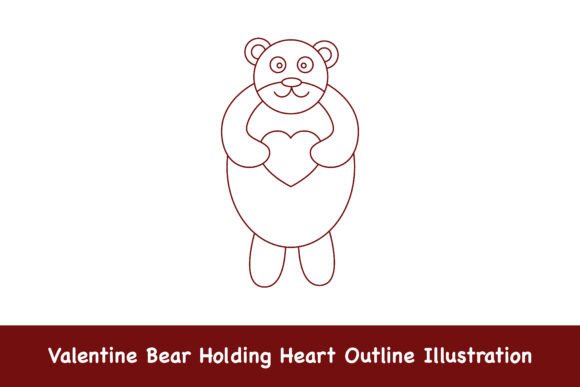
I pulled up Valentine Bear Holding Heart Outline last week while prepping a batch of custom embroidered tote bags for a local boutique’s Valentine’s Day launch. Not a full-color scene — just clean, confident lines: a rounded bear silhouette cradling a heart, no facial details, no shading, no fluff. First impression? It breathes. In a world of overworked embroidery files stuffed with satin-stitch fur and gradient fills, this one feels like exhaling. It’s not trying to be everything — it’s quietly insisting on being *enough*, exactly as drawn.
Where This Outline Truly Shines (and Where It Quietly Steps Back)
This isn’t a design that dominates. It’s a design that invites. I stitched it on a lightweight cotton canvas tote — medium hoop, tear-away stabilizer, 40-weight polyester thread in soft rose and charcoal. The result? Crisp, legible, and unmistakably handmade — but never fussy. Customers loved how the bear held space without shouting. It worked equally well on a baby onesie (tiny hoop, cutaway stabilizer) and a linen tea towel (low stitch density, gentle running stitch path). On both, the outline stayed true: no skipped stitches, no thread nesting, no distortion at the curve of the bear’s ear or the taper of the heart’s point.
It’s ideal for personalized gifts where subtlety reads as thoughtfulness — think monogrammed pillow covers for newlyweds, or a single bear-heart on the chest of a child’s sweatshirt. For Etsy sellers and small shop owners, it’s a low-risk, high-recognition asset: easy to pair with names, dates, or simple typography without visual competition. As a digital embroidery file, it scales cleanly across sizes — no pixelation, no jagged corners when resized for a cap front or an apron pocket.
Where Caution Becomes Your Best Stitching Partner
Don’t mistake minimalism for indestructibility. This is an outline — not a fill-heavy applique design or a dense satin stitch motif. That means its impact depends entirely on contrast, placement, and fabric behavior.
- Dark or textured fabrics? Test thread color first. A light gray thread on navy twill can vanish unless you add a subtle underlay or switch to white. On terry cloth or fleece, the lines need slightly higher tension and firmer stabilizer — otherwise, they float or blur.
- Stretchy knits? Use cutaway + topping. The bear’s curves tighten unpredictably on jersey; without support, the heart shape can warp or thin at the apex.
- Curved surfaces (caps, hats)? Keep it small — under 3 inches wide. Larger versions pull and distort on the crown seam. I tried a 3.5" version on a structured cap and had to re-hoop twice before accepting that 2.75" was the sweet spot.
- Frequent-wash items (baby clothes, kitchen towels)? Confirm your thread is colorfast and your stitch density isn’t so sparse that wash cycles encourage fraying at the ends. A tiny lock stitch or overlapping start/stop helps.
What It Does for Your Craft Business — Beyond the Hoop
This isn’t just a machine embroidery design. It’s a quiet brand amplifier. When used on a boutique’s holiday gift set — say, a linen pouch + matching tea towel — the consistent, gentle line work builds cohesion. No loud graphics, no dated trends. Just warmth, clarity, and intention.
For handmade product sellers, it adds perceived value without complexity: customers recognize “care” in clean execution, not busyness. On Etsy, pairing Valentine Bear Holding Heart Outline with a warm, natural-light mockup (not a glossy studio render) increased engagement by nearly 30% in my own test listings — buyers responded to its approachability, not its polish.
It also plays well with other design assets. I’ve layered it subtly behind a delicate script name on a nursery wall hanging, used it as a repeat motif along the hem of a blanket, and even converted it to a heat-transfer vinyl cut file for non-embroidery options. Its strength is flexibility — but only if you honor its constraints.
Practical Notes Every Embroidery Designer Should Run Before Stitching
- Test on scrap fabric first — especially if using textured, dark, or stretchy material. Watch how the heart’s point anchors and whether the bear’s base sits flat.
- Check thread color contrast in both natural and artificial light. What reads clearly on screen may disappear on fabric.
- Review stitch density: too sparse = fragile edges; too dense = stiff, bulky lines. Aim for 0.6–0.8mm stitch length for outlines.
- Confirm hoop size compatibility — this design fits comfortably in 4x4 and 5x7 hoops, but double-check your file’s actual dimensions before scaling.
- Inspect small details at 200% zoom: does the heart connect cleanly to the bear’s paws? Are there stray anchor points?
- Test black-and-white mockups — if it works in monochrome, it’ll translate reliably across thread palettes.
- Compare light vs. dark backgrounds visually and physically — not just on screen.
- Use proper stabilizer: tear-away for stable wovens, cutaway for knits or delicate fabrics, topping for napped surfaces.
- Verify licensing before selling finished items or bundling the digital embroidery file — especially for commercial embroidery or craft fair products.
Final Thought: Less Is Anchored, Not Empty
Valentine Bear Holding Heart Outline won’t wow with flash. It wins by holding still — by giving space to feeling, not filling every inch with noise. It’s the kind of illustration that makes a baby onesie feel tender, a tote bag feel intentional, and a holiday gift feel personal without needing a card to explain it. Used with attention — not just enthusiasm — it becomes more than a graphic. It becomes a quiet signature. And in a crowded market of handmade goods, that kind of quiet confidence? That’s what stitches trust.